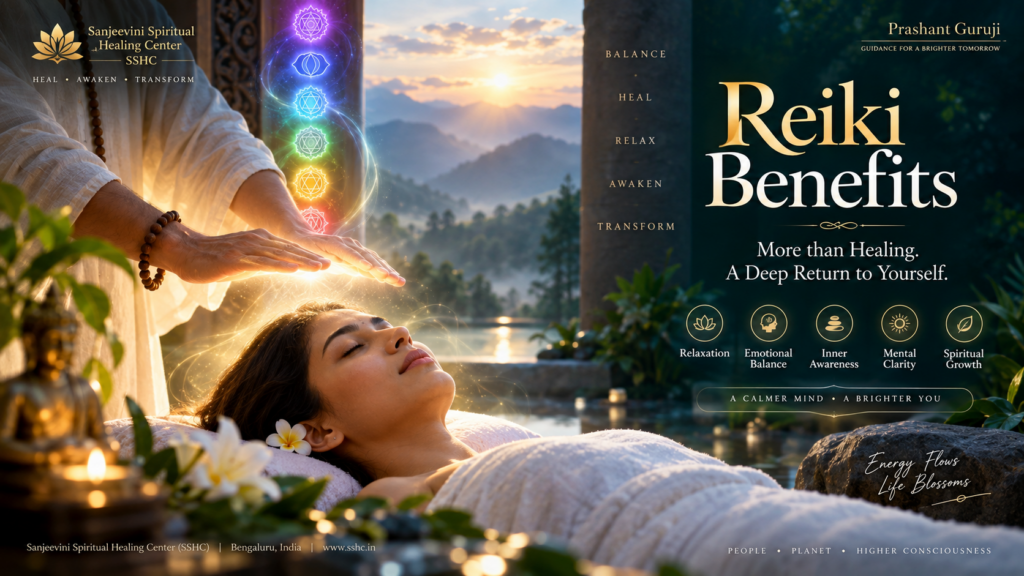
Reiki Benefits
Explore the many dimensions through which people experience Reiki, from stillness and relaxation to meditation, emotional reflection, subtle-energy awareness and deeper spiritual enquiry.
What does Reiki actually give you?
Perhaps the most interesting Reiki benefit is not something that can be held in the hand, measured in a photograph or reduced to a single sensation. It may begin with the simple experience of becoming quiet enough to notice yourself.
Reiki is commonly explored as a complementary spiritual and energy-based practice involving gentle touch or hands positioned near the body. Different Reiki lineages understand the practice in different ways.
People may seek Reiki for relaxation, a period of stillness, meditation, emotional reflection, spiritual exploration or a greater sense of connection with their inner experience.
What people commonly explore through Reiki
Reiki experiences are individual. The following dimensions describe common reasons people explore the practice rather than promises of a particular outcome.
Deep Relaxation
A Reiki session can create a quiet environment in which the body and mind are given an opportunity to slow down. For some people, this simple pause becomes one of the most meaningful aspects of the experience.
Inner Stillness
Modern life constantly pulls attention outward. Reiki can provide a dedicated period in which external stimulation decreases and attention turns inward.
Present-Moment Awareness
During a quiet session, sensations, thoughts and subtle shifts in awareness may become easier to notice. This can encourage a more observant relationship with the present moment.
Meditative Support
Reiki can be explored alongside meditation as a complementary contemplative practice. The emphasis can gradually shift from seeking an experience to learning how to remain present.
Emotional Reflection
Quiet periods sometimes make emotional patterns more noticeable. Reiki can offer a reflective environment in which feelings can be observed without immediately reacting to them.
Spiritual Exploration
For those approaching Reiki from a spiritual perspective, the practice may become an entry point into questions concerning consciousness, presence, intuition and the nature of inner experience.
Body Awareness
Warmth, coolness, heaviness, lightness, tingling or other sensations may become more noticeable during a session. These sensations can be observed without assigning one fixed meaning to them.
Quiet Mental Space
Reiki may provide a temporary break from constant mental activity. The value may lie not in eliminating thoughts, but in changing the relationship with them.
Self-Observation
As attention becomes quieter, recurring thoughts, emotional reactions and bodily patterns may become easier to observe. This can deepen personal enquiry.
Reiki benefits beyond the physical experience
The doorway may be relaxation. The enquiry can become much deeper.
Reiki is often introduced through the language of energy and healing. Yet a person who remains with the practice may eventually become more interested in awareness itself.
What happens when attention stops chasing every thought? What happens when the body is allowed to become quiet? What becomes noticeable when the need to interpret every sensation is temporarily suspended?
These questions move Reiki into a contemplative territory where the practice becomes less about searching for dramatic experiences and more about observing consciousness with patience.
How Reiki may be experienced on different levels
Physical Relaxation
The quiet setting and stillness of a session may help create a subjective sense of physical relaxation and rest.
Sensory Awareness
Subtle bodily sensations can become more noticeable when attention is no longer occupied by constant external activity.
Emotional Awareness
Quietness can sometimes reveal emotions that were previously overshadowed by activity, distraction or habitual reactions.
Mental Observation
Reiki can become an opportunity to observe thoughts without immediately following every thought into another story.
Contemplative Awareness
Repeated periods of stillness can encourage curiosity about attention, awareness and the difference between observing experience and reacting to it.
Intention
Reiki practice may encourage a more conscious relationship with intention, compassion and the direction of attention.
Presence
Instead of continuously living in memory or anticipation, the practice can invite greater attention toward the immediate experience.
Spiritual Enquiry
Some practitioners use Reiki as a starting point for deeper questions about consciousness, subtle experience and the nature of inner transformation.
Integration
The deeper value of a contemplative practice may emerge outside the session, through how awareness is carried into ordinary relationships, work and daily life.
Compassion
Many Reiki teachings emphasize compassion and kindness, creating an opportunity to explore how inner attitudes influence everyday experience.
What might you actually feel during Reiki?
There is no single Reiki experience that everyone must have.
Some people report warmth, coolness, tingling, heaviness, lightness, relaxation or a sense of spaciousness. Others may experience emotional movement, memories, imagery or simply ordinary quietness.
An important part of approaching Reiki with discernment is recognizing that an unusual sensation does not automatically prove a particular energetic or spiritual explanation. The experience can be meaningful without requiring a rigid interpretation.
When Reiki becomes a practice of stillness
From sensation to awareness
A beginner may focus on what they feel during Reiki. With greater familiarity, attention can gradually shift from the sensation itself toward the awareness that notices the sensation.
This subtle shift can be important. Instead of asking only, “What am I feeling?”, the practitioner may begin asking, “Who is noticing this experience?”
From seeking to observing
Spiritual practices can become more interesting when the constant search for extraordinary experiences becomes quieter.
Reiki can then be approached as a practice of presence, receptivity and observation rather than as a hunt for dramatic sensations.
Benefits that begin outside the Reiki session
The Reiki tradition also places importance on principles intended to influence everyday living.
Just for today…
The Five Reiki Principles can be understood as a practical invitation to bring awareness into ordinary life rather than limiting Reiki to the treatment space.
Reiki benefits and chakra awareness
Reiki and the chakra system come from different historical traditions. Modern practitioners sometimes combine Reiki with chakra meditation and energy work.
Within that contemporary framework, Reiki may be used as a quiet setting for exploring body awareness, attention and symbolic associations connected with different chakra traditions.
The purpose of such exploration is not to force every sensation into a predetermined explanation, but to approach subtle experience with curiosity and discernment.
| Area of Exploration | Common Contemporary Association | Inner Enquiry |
|---|---|---|
| Root | Grounding and stability | How present am I in my body? |
| Sacral | Creativity and emotional flow | How do I relate to feeling? |
| Solar Plexus | Will and personal direction | How consciously do I act? |
| Heart | Compassion and connection | Can awareness become kinder? |
| Throat | Expression and communication | How truthfully do I express myself? |
| Ajna | Insight and observation | Can I observe without immediately reacting? |
| Crown | Spiritual awareness | What happens when attention becomes spacious? |
Can Reiki create emotional shifts?
A quiet environment can sometimes make emotional material more noticeable. When external activity decreases, feelings that were previously hidden beneath busyness may become easier to recognize.
This does not mean that every emotion appearing during Reiki has a mystical cause. Human beings naturally experience changing thoughts, memories, emotions and bodily sensations when they become quiet.
The contemplative opportunity is to observe these experiences with patience rather than immediately turning them into conclusions.
The real Reiki benefit may appear later
Awareness
Becoming more aware of thoughts, sensations and emotional reactions in everyday situations.
Pause
Learning that there can be a space between an experience and the reaction that follows it.
Presence
Bringing attention back from constant mental projection into the experience of the present moment.
Compassion
Exploring whether greater inner awareness can influence the way one relates to oneself and others.
Discernment
Learning to distinguish direct experience from assumptions about what an experience must mean.
Stillness
Discovering that stillness does not necessarily mean the absence of thought, but a quieter relationship with thought.
Intention
Becoming more conscious of where attention is directed and what qualities one wishes to cultivate.
Integration
Allowing insights from contemplative practice to become part of ordinary daily living.
What science says about Reiki benefits
Reiki is considered a complementary health approach. Research has examined Reiki in areas including anxiety, pain and other outcomes, but the evidence remains mixed and the quality of studies varies.
Some recent reviews have reported possible benefits for anxiety or certain short-term outcomes, while major evidence-based health resources note that there is not yet enough high-quality evidence to establish Reiki as an effective treatment for specific health conditions.
This distinction is important. A person may find a Reiki session relaxing, meaningful or spiritually valuable without those subjective benefits establishing Reiki as a medical treatment.
Reiki as a doorway into deeper awareness
Prashant Guruji
At Sanjeevini Spiritual Healing Center (SSHC), Reiki is approached within a broader framework of spiritual exploration, awareness and complementary healing.
Under the guidance of Prashant Guruji, with nearly 2 decade experience in spiritual and complementary healing work, Reiki can be explored not merely as a technique, but as an opportunity to become quieter, more observant and more conscious of one’s inner experience.
The emphasis is not on creating dramatic expectations. The deeper enquiry is whether stillness, awareness, intention and compassionate observation can gradually change the way a person experiences themselves and the world around them.
Reiki may also be explored alongside meditation, energy work, chakra-focused practices and other SSHC approaches according to the individual’s enquiry.
Continue deeper into the subject
Reiki becomes more meaningful when its different dimensions are explored rather than reduced to a single definition.
Reiki Benefits FAQ
What are the main benefits of Reiki?
People commonly explore Reiki for relaxation, quietness, present-moment awareness, meditation, emotional reflection, body awareness and spiritual enquiry. Individual experiences vary considerably.
Can Reiki help with relaxation?
Reiki sessions are generally conducted in a calm environment, and many people explore them as a relaxation and contemplative practice. The experience can differ from person to person.
Can Reiki help with stress?
Some people use Reiki as a quiet period for relaxation and reflection. Research into Reiki and anxiety has produced mixed findings, and Reiki should not be presented as a replacement for appropriate professional care.
Can Reiki support meditation?
Yes, Reiki and meditation can be explored together as complementary contemplative practices. They remain distinct traditions with different histories and methods.
Can Reiki help emotional balance?
A quiet Reiki session may provide space for emotional reflection and observation. People can respond differently, and Reiki should not be treated as a substitute for qualified mental-health care.
Can Reiki improve energy?
Within Reiki traditions, practitioners commonly describe the practice using the language of energy and life force. From a scientific perspective, the specific energy field proposed by Reiki has not been established. People may nevertheless describe subjective changes in relaxation, alertness or inner experience.
Can Reiki be combined with chakra healing?
Some modern practitioners combine Reiki with chakra-focused practices. Reiki and chakra systems have different historical origins, so the combination is best understood as a contemporary integrative approach.
Can Reiki be practiced remotely?
Some Reiki lineages and practitioners offer distance or remote sessions. These practices are understood within particular Reiki traditions.
How long does it take to experience Reiki benefits?
There is no universal timeline. Some people notice relaxation or quietness during an initial session, while others experience subtler changes over repeated practice. Individual responses vary.
Do I need to believe in Reiki for it to be meaningful?
A person can approach Reiki with curiosity rather than a fixed belief. Direct observation, openness and discernment can be more useful than forcing either belief or disbelief onto every experience.
Is Reiki a medical treatment?
Reiki is a complementary practice and should not replace diagnosis, treatment or advice from qualified medical or mental-health professionals.
How can I enquire about Reiki Benefits and Reiki Healing with SSHC?
You can contact Sanjeevini Spiritual Healing Center through WhatsApp or phone at +91 9611656951 to enquire about Reiki, Reiki Benefits and related SSHC services.
Perhaps the deepest Reiki benefit is learning to become still enough to listen.
Explore Reiki not simply as something to receive, but as an invitation to discover what becomes visible when attention becomes quiet.
Prashant Guruji
Founder, Sanjeevini Spiritual Healing Center (SSHC)
Rajajinagar, Bengaluru, Karnataka, India